Your Moon Sign: What It Means and How to Find It
Most people know their Sun sign. It is the one printed in magazine columns and mentioned over dinner. Fewer people know their Moon sign, yet many find that it…
Read the guide⌂︎Houses and points
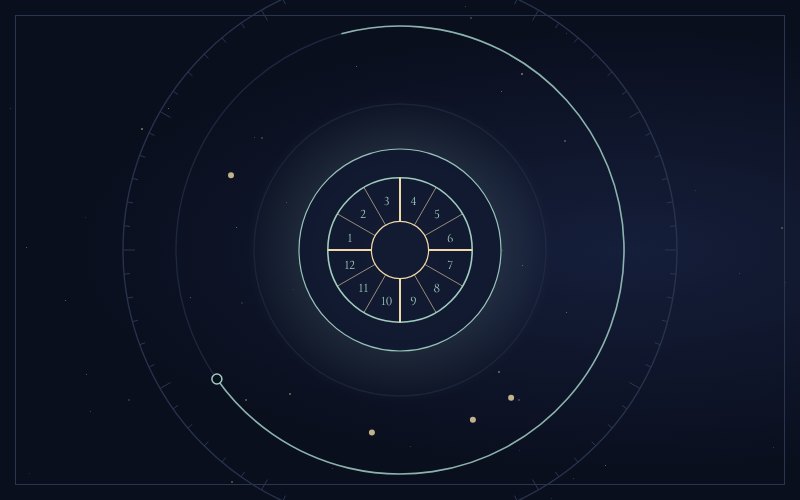
If the planets in a birth chart describe what is happening and the signs describe how, the houses describe where. They divide the chart into twelve areas of life, from personal identity and money to home, work, partnership and the inner world. Learning the houses is often the moment a chart stops looking abstract and starts to feel personal.
By Astromeridia Editorial12 November 2026Updated 12 November 2026
Astrology is offered here for self-reflection and entertainment. House placements describe themes and areas of attention; they do not determine events and are not medical, financial, legal or psychological advice.
The houses are twelve sections of the birth chart based on the Earth's daily rotation. While the zodiac signs are linked to the Sun's yearly path, the houses are linked to the horizon and the meridian of the place of birth at a given moment. That is why they turn fully once in about twenty-four hours.
Each house has a starting line called a cusp. The sign on a cusp colours the matters of that house, and any planets inside it bring their own energy to that area of life.
Because the houses move so quickly, they depend on the time of birth. The Ascendant, which marks the start of the first house, changes sign roughly every two hours. A difference of even a few minutes can move a cusp from one sign to another.
Without a birth time, the houses, the Ascendant and the Midheaven (MC) cannot be calculated. With an approximate time, house placements should be read with caution.
If the time is not known, the planets in their signs and their aspects can still be read. Our page on the birth chart without a birth time explains what remains available. To see your own houses, enter your details in the free birth chart calculator.
There are several ways to divide the sky into twelve houses. Placidus is widely used in modern Western astrology. Whole Sign houses, an older method, make each house a complete sign. Equal houses divide the chart into twelve sections of 30 degrees from the Ascendant. Different systems can place a planet in a neighbouring house, especially near a cusp, so it is worth knowing which one a chart uses.
The houses are grouped into three families:
The first house begins at the Ascendant. It describes personal style, the body, first reactions and the way someone steps into new situations. Planets here tend to be noticeable in the personality.
This house covers personal belongings, earned income and, more deeply, what a person values and what helps them feel secure. It also relates to self-worth.
Everyday conversation, writing, short journeys, early schooling, siblings and the local neighbourhood belong here. It shows how the mind gathers and shares information.
Beginning at the IC, the fourth house describes home, family, ancestry and the private foundations of life. It is often read as the place a person returns to emotionally.
Play, romance, hobbies, self-expression and children are linked with the fifth house. It shows what brings joy and what a person enjoys creating.
Daily tasks, habits, service, colleagues and the care of the body through routine are sixth-house themes. It describes how a person organises ordinary life.
Starting at the Descendant, the seventh house covers close one-to-one relationships, including marriage and business partners. It also describes qualities a person often looks for in others.
Intimacy, trust, joint finances, inheritance and deep change are eighth-house matters. It is linked with what is shared and what is let go.
Higher learning, philosophy, long journeys, foreign cultures and the search for meaning live here. It describes how a person expands their view of the world.
Beginning at the Midheaven, the tenth house describes career direction, reputation, ambitions and the role a person takes on in the wider world.
Friendships, groups, networks, shared causes and hopes for the future are eleventh-house themes. It shows where a person finds belonging among peers.
The twelfth house relates to solitude, rest, dreams, the unconscious and what happens behind the scenes. It is often read as a space for retreat and quiet reflection.
To read a planet in a house, combine its function with the area of life. Mars in the third house may suggest a lively, direct way of speaking. Venus in the sixth house may describe pleasure found in a well-run routine or a pleasant workplace. Saturn in the fourth house may point to a strong sense of responsibility towards home and family.
The sign on the cusp adds another layer. A tenth house with Leo on its cusp might describe a wish to be visible and appreciated in one's work, even if no planets sit there.
House readings describe areas of emphasis, not outcomes. A planet in the second or eighth house says nothing certain about earnings or losses, and a planet in the sixth house is not a statement about health.
With ten planets and twelve houses, some houses will always be empty. An empty house is not a missing piece of life. That area is read through the sign on its cusp and the position of the planet that rules that sign. Sometimes an empty house simply describes an area that runs quietly without needing much attention.
The houses also work in opposite pairs, and reading them as axes can reveal a balance the chart is asking for. The first and seventh houses form the axis of self and other: independence on one side, partnership on the other. The second and eighth houses pair what is personally owned with what is shared. The third and ninth houses link everyday knowledge with wider beliefs. The fourth and tenth houses balance private roots and public direction. The fifth and eleventh houses connect personal joy with collective hopes, while the sixth and twelfth houses pair daily effort with rest and retreat. When planets gather at one end of an axis, the opposite house often describes a quality worth developing.
The houses become richer when combined with the rest of the chart. The house of the Moon, for instance, shows where emotional needs are most active; our Moon sign guide explains how. For a complete method that brings signs, planets, houses and aspects together, read how to read a birth chart.
When you would like every house interpreted for you, the full birth chart reading describes each planet in its sign and house in one personal report.
All readings are for self-reflection and entertainment. For health, emotional difficulties, money or legal matters, please consult a qualified professional.
They are twelve sections of the birth chart, each linked to an area of life: self, resources, communication, home, creativity, routine, partnership, shared resources, beliefs, vocation, community and the inner world.
Yes. The houses depend on the time and place of birth. Without a birth time they cannot be calculated, and with an approximate time they should be read with caution.
Nothing is missing. An empty house is read through the sign on its cusp and the planet that rules that sign.
There is no single correct system. Placidus, Whole Sign and Equal houses are all widely used. Many people try more than one and see which feels most descriptive.
Signs describe how a planet expresses itself and are based on the Sun's yearly path. Houses describe where in life that energy shows up and are based on the Earth's daily rotation.
Career and public life are mainly tenth-house themes. Romance is linked with the fifth house, and committed partnership with the seventh. Other placements also contribute.
Share
Most people know their Sun sign. It is the one printed in magazine columns and mentioned over dinner. Fewer people know their Moon sign, yet many find that it…
Read the guideA birth chart can look like a puzzle at first: a wheel, a ring of symbols, lines criss-crossing the centre. Yet the logic behind it is simple once the pieces…
Read the guideMost people know their Sun sign from weekly horoscopes. The rising sign, also called the Ascendant, is just as useful and far less often discussed. It is the…
Read the guide