Your Moon Sign: What It Means and How to Find It
Most people know their Sun sign. It is the one printed in magazine columns and mentioned over dinner. Fewer people know their Moon sign, yet many find that it…
Read the guide✦︎Basics
A birth chart can look like a puzzle at first: a wheel, a ring of symbols, lines criss-crossing the centre. Yet the logic behind it is simple once the pieces are named. This guide walks through each part in a sensible order, so that a first chart becomes something you can actually read rather than just admire.
By Astromeridia Editorial12 November 2026Updated 12 November 2026
Astrology is presented here as a language for self-reflection and entertainment. A birth chart describes tendencies and themes; it does not determine events, health, relationships or money, and it is not a substitute for professional advice.
A birth chart, also called a natal chart, is a map of the sky drawn for a particular moment and place: the moment of birth, seen from the town or city of birth. It shows where the Sun, the Moon and the planets were in the zodiac, and, when the birth time is known, how the sky was divided into twelve houses around the horizon.
Think of it as a snapshot. The planets describe *what* is active, the signs describe *how* it is expressed, and the houses describe *where* in life it tends to show up.
Every chart starts from three details:
The time matters more than many people expect. The Ascendant moves through a whole sign in roughly two hours, and the houses shift with it. A birth certificate or a hospital record is usually the most reliable source.
Without a birth time, the Ascendant, the Midheaven (MC) and the houses cannot be calculated, and the Moon's sign may be uncertain on some days. A chart is only as accurate as the data entered.
You can draw your own chart with our free birth chart calculator. If the time is missing, see the birth chart without a birth time page for what can still be read.
The circle is divided in two ways at once.
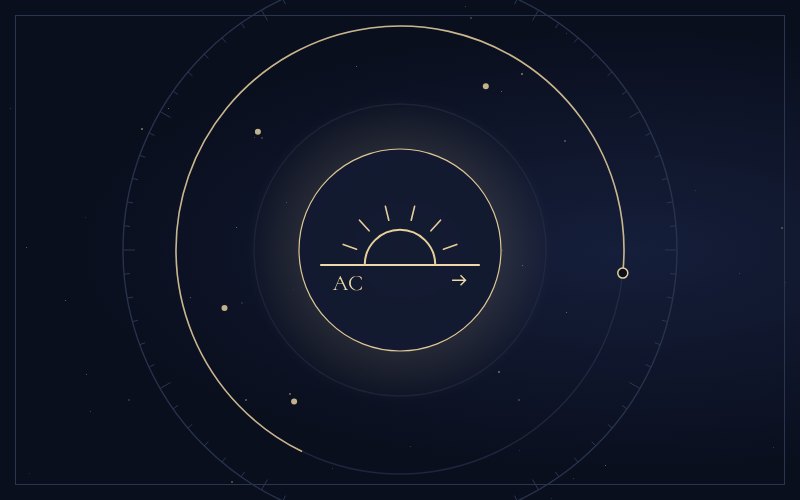
The horizontal line across the chart is the horizon. Its left end is the Ascendant, the sign rising in the east at birth. Its right end is the Descendant. The near-vertical line marks the Midheaven (MC) at the top and the IC at the bottom. These four points are called the angles, and they depend on the birth time.
Planets above the horizon line were visible in the sky at birth; planets below it were under the horizon. Some astrologers read this as a balance between a public and a private emphasis.
Beginners often find it helpful to read three placements first.
Reading these three together already gives a rounded first sketch. A fiery Sun with a watery Moon and an earthy Ascendant, for example, suggests someone whose drive, feelings and outward style each speak a slightly different language.
Each planet represents a basic drive or function.
A good habit is to phrase each placement as a sentence: *planet* (what) is expressed *in the style of the sign* (how) *in the area of the house* (where). For example, "Venus in Gemini in the fifth house" might be read as affection expressed through playful conversation, especially in romance and creative pastimes.
The signs colour the planets. They can be grouped to make them easier to remember.
By element
By modality
Counting how many planets fall in each element and modality gives a quick sense of the overall temperament of the chart.
When the birth time is known, the twelve houses show the areas of life where the planets are most active: self, resources, communication, home, creativity, work, partnership, shared resources, beliefs, vocation, community and the inner world.
A house with several planets suggests an area that draws a lot of attention. An empty house is not a problem; that area is simply read through the sign on its cusp and the planet that rules it. The guide to the astrological houses explains all twelve.
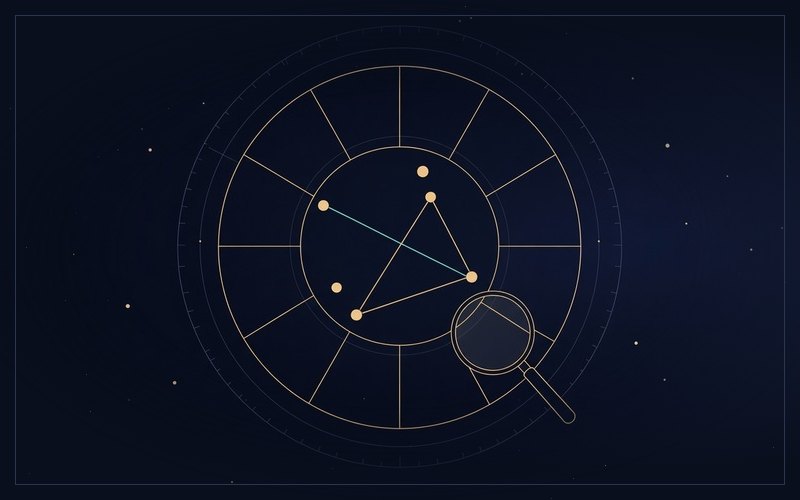
The lines inside the wheel are aspects: specific angles between planets. They show how different parts of the chart talk to each other.
Aspects are given an orb, a small margin of tolerance. Closer aspects are usually felt more strongly. Tense aspects are not "bad"; they often describe the parts of life where people build the most strength.
Once the pieces are clear, look for repeated themes. If the Sun is in Capricorn, Saturn is prominent and the tenth house is busy, the theme of responsibility and achievement is being underlined three times. Repetition is one of the most reliable guides to what matters most in a chart.
It also helps to notice contradictions. A Moon that seeks safety and a Mars that seeks risk can describe an inner dialogue rather than a fault. Good chart reading holds both sides without forcing a verdict.
Interpretations describe possibilities and inner tendencies. Choices remain entirely the person's own, and no placement should be taken as a reason to make or avoid medical, financial or legal decisions.
Reading a chart is a skill that improves with practice. Start with your own, then try the charts of people you know well and see which descriptions ring true. When you want a detailed interpretation written out for you, the full birth chart reading explains every planet, sign, house and major aspect in one personal report.
All readings are for self-reflection and entertainment. For health, emotional difficulties, money or legal matters, please consult a qualified professional.
There is none. Both terms describe the map of the sky at the moment and place of birth. "Natal" simply means relating to birth.
Yes, in part. The signs of the Sun and planets and most aspects can still be read. The Ascendant, the Midheaven and the houses need a birth time, and the Moon's sign may be uncertain on some days.
Start with the Sun, the Moon and the Ascendant. Then move to the planets in their signs, the houses and finally the aspects.
They are aspects, the angles between planets. Each type of line shows a different kind of relationship, from easy flow to creative tension.
The Sun sign depends on the date, while the rising sign depends on the time and place. The rising sign changes roughly every two hours, so it is often different from the Sun sign.
The basics can be learnt in a few evenings. Reading charts with depth and nuance is a skill that keeps growing with practice and curiosity.
Share
Most people know their Sun sign. It is the one printed in magazine columns and mentioned over dinner. Fewer people know their Moon sign, yet many find that it…
Read the guideIf the planets in a birth chart describe what is happening and the signs describe how, the houses describe where. They divide the chart into twelve areas of…
Read the guideMost people know their Sun sign from weekly horoscopes. The rising sign, also called the Ascendant, is just as useful and far less often discussed. It is the…
Read the guide