Your Rising Sign: What It Means and How to Read It
Most people know their Sun sign from weekly horoscopes. The rising sign, also called the Ascendant, is just as useful and far less often discussed. It is the…
Read the guide♀︎Love and relationships
Most people first meet astrological compatibility through Sun signs: an Aries with a Libra, a Cancer with a Scorpio. It is a friendly starting point, but it only looks at one placement in each chart. Synastry goes much further. It places two complete birth charts side by side and looks at how the planets of one person meet the planets and life areas of the other.
By Astromeridia Editorial16 November 2026Updated 16 November 2026
This guide explains what synastry is, how two charts are compared, why the Sun, Moon, Venus and Mars carry so much weight, why birth time matters and, just as importantly, what synastry cannot tell you. For a quick first look at two signs, try the compatibility tool. For a full written comparison of two charts, see the synastry report.
All readings are for self-reflection and entertainment. For health, emotional difficulties, money or legal matters, please consult a qualified professional.
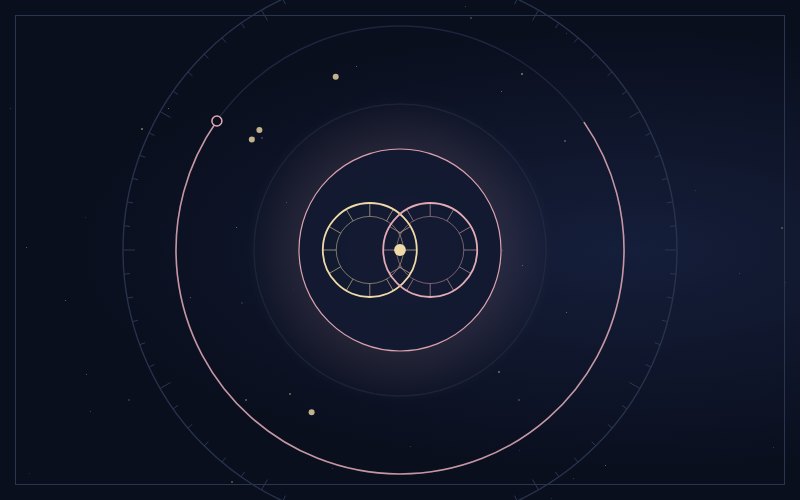
Synastry is the comparison of two birth charts. Each chart is a picture of the sky at the moment and place someone was born. When two of those pictures are laid over each other, astrologers can see where the two people naturally connect, where they spark each other and where they may need more patience.
Synastry is most often used for couples, but it works for any close bond: friends, siblings, a parent and child, business partners or colleagues. It does not give the relationship a score. It describes a dynamic, the particular way two people tend to affect each other.
If you are new to charts, our guide on how to read a birth chart explains the basic pieces: signs, planets and houses. Synastry uses the same pieces, only for two people at once.
A synastry reading usually looks at two things: the aspects between the two sets of planets, and the houses where one person's planets fall in the other person's chart.
An aspect is a meaningful angle between two planets. In synastry, the interest lies in the angles between one person's planets and the other person's. When one partner's Moon sits close to the other's Venus, for example, there is often an easy warmth and a shared sense of comfort.
Aspects fall broadly into two groups:
A chart full of easy aspects is not automatically "better". Some friction keeps a bond alive and pushes both people to grow. What matters is how the whole picture fits together.
The houses are the twelve life areas of a chart, such as home, communication, partnership and career. In synastry, one person's planets are placed into the other person's houses. This is called a house overlay.
If one partner's Sun falls in the other's fourth house, the house of home and roots, the relationship may feel like a place of belonging. If one partner's Mercury falls in the other's third house, conversation may flow easily. House overlays describe where in life each person feels the other's presence most.
Houses depend on the birth time, which is why an accurate time makes such a difference. More on that below.
Every planet has a part to play, but four of them are usually read first because they speak directly about connection.
The Sun describes the sense of self and what a person is growing towards. When one person's Sun connects with the other's chart, there is often recognition: a sense of being seen for who you are. Sun contacts tend to show where the two people support each other's identity.
The Moon describes emotional needs, moods and the things that make someone feel safe. In synastry, Moon contacts often say a great deal about daily life together: how comfort is given and received, and whether each person feels understood without having to explain. Our Moon sign guide explores the Moon on its own.
Venus describes affection, pleasure, taste and the way someone shows love. Venus contacts point to tenderness, shared enjoyment and mutual appreciation. When one person's Venus touches the other's Sun or Moon, there is often a natural fondness that is easy to feel.
Mars describes drive, desire and how someone acts when they want something. In synastry, Mars contacts bring energy and attraction, and sometimes heated disagreements. A Venus and Mars connection between two charts is one of the classic signs of chemistry. A tense Mars contact may simply mean the couple needs fair ways to handle conflict.
The rising sign, or Ascendant, describes first impressions and personal style, so contacts to it often show how quickly two people feel drawn to each other. Our guide to the rising sign explains it in detail. Mercury speaks about communication, Jupiter about shared growth and generosity, and Saturn about commitment, responsibility and the lessons that take time. The slower outer planets add depth, though they tend to describe a whole generation as much as an individual bond.
The Sun, Venus and Mars move slowly enough that a birth date gives a fair idea of their signs. The Moon moves more quickly and can change sign during a single day. The rising sign and the houses change every couple of hours.
That means a synastry reading without birth times can still describe the planet-to-planet aspects, but it cannot show house overlays or contacts to the rising sign with confidence. Where a time is only approximate, the most time-sensitive details should be read as possibilities.
A birth certificate or hospital record is usually the most reliable source. If you have both sets of details, the free birth chart calculator is a good place to see each chart on its own before comparing them.
Synastry is a tool for understanding, not a verdict. It is worth being clear about its limits.
Used well, synastry offers language for things you may already sense: why some conversations flow, why certain topics feel sensitive and where each person might meet the other halfway.
Synastry compares two separate charts. Astrologers sometimes also build a composite chart, a single chart made from the midpoints of both people's planets, which describes the relationship as if it were a third entity. The two methods complement each other. Synastry shows how two people affect each other; the composite chart describes the shared character of the bond.
The best way to understand synastry is to start with each person's chart on its own. The free birth chart calculator shows the planets and houses, and the full birth chart reading explains every placement in writing.
When you are ready to see two charts together, the synastry report describes the main aspects, the house overlays and the role of the Sun, Moon, Venus and Mars between you. For a lighter first look, try the compatibility tool.
All readings are for self-reflection and entertainment. For health, emotional difficulties, money or legal matters, please consult a qualified professional.
Synastry is the comparison of two birth charts. It looks at how one person's planets connect with the other person's planets and houses, to describe the dynamic between them.
Not for every part of it. Planet-to-planet aspects can be read from dates alone, with some care around the Moon. House overlays and the rising sign need both birth times and places.
No. It is most often used for romantic relationships, but it works for any close bond, including friendships, family relationships and working partnerships.
Not necessarily. Challenging aspects show friction, but they often come with attraction and growth. Many strong relationships contain a mix of easy and challenging contacts.
Sun sign compatibility compares only the two Sun signs. Synastry compares the full charts, including the Moon, Venus, Mars, the rising sign and the houses, so it gives a much more detailed picture.
Share
Most people know their Sun sign from weekly horoscopes. The rising sign, also called the Ascendant, is just as useful and far less often discussed. It is the…
Read the guideMost people know their Sun sign. It is the one printed in magazine columns and mentioned over dinner. Fewer people know their Moon sign, yet many find that it…
Read the guideIf the planets in a birth chart describe what is happening and the signs describe how, the houses describe where. They divide the chart into twelve areas of…
Read the guide